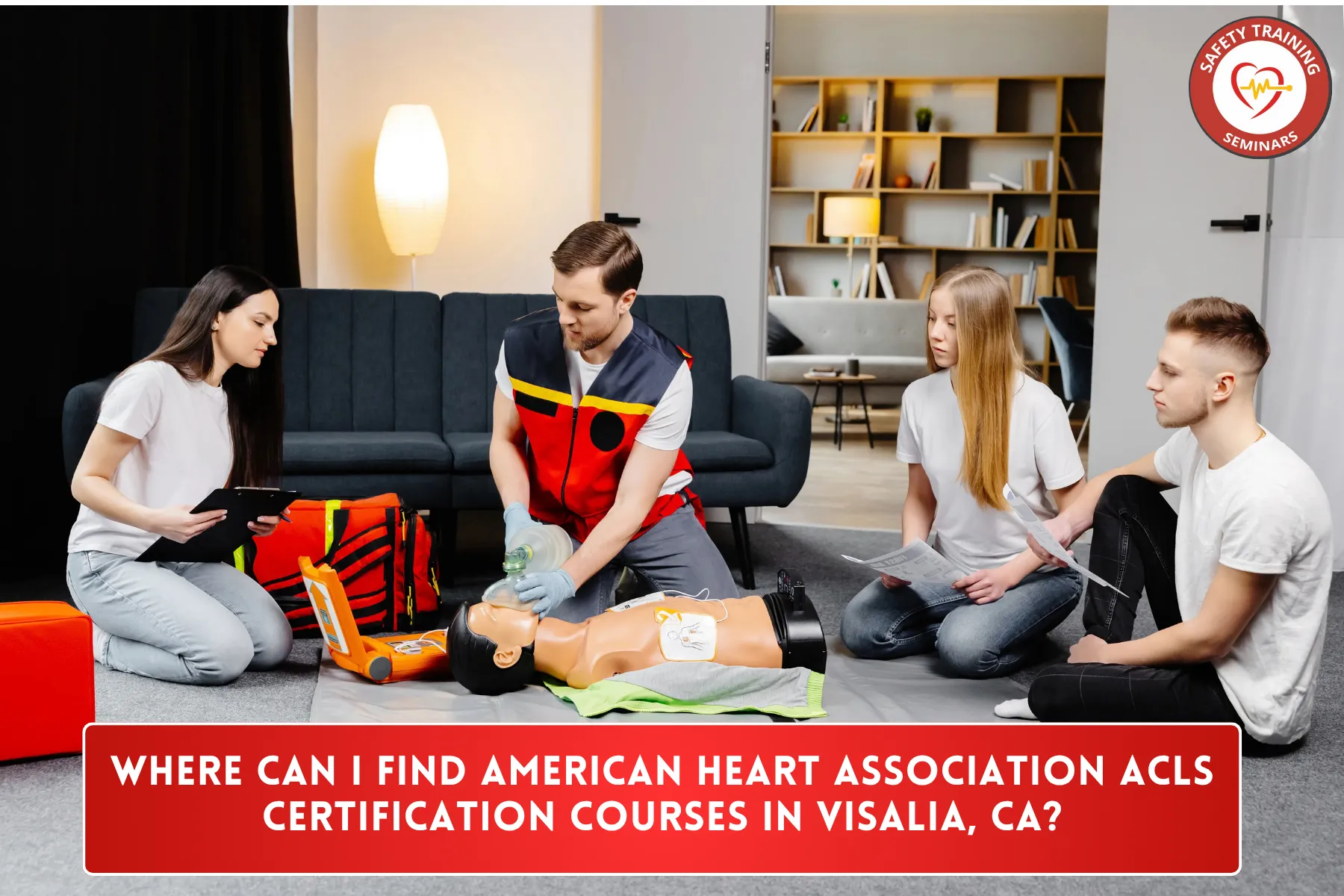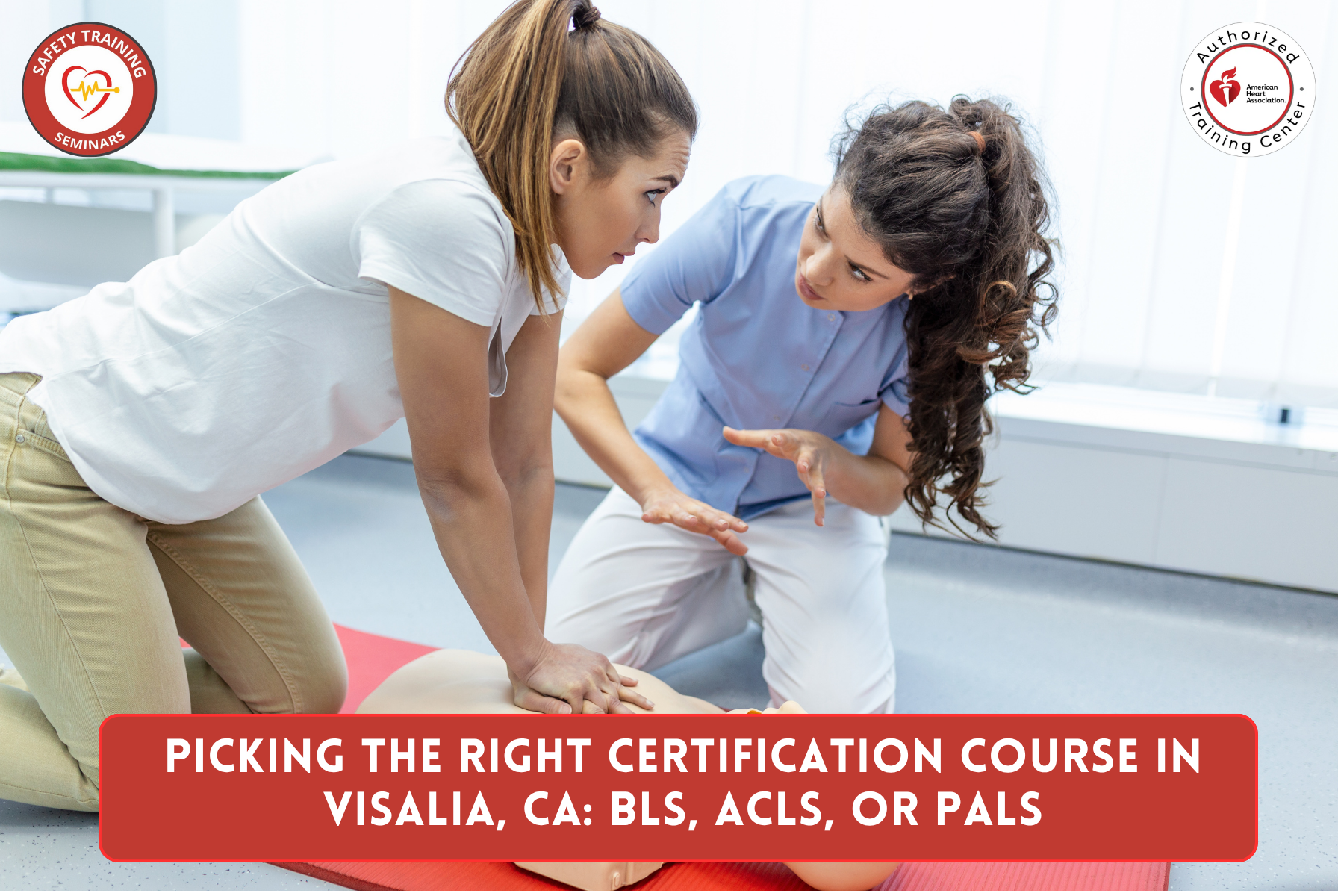
You can take American Heart Association PALS certification courses in Visalia at the Safety Training Seminars training center on West Noble, in the southwest part of the city. Safety Training Seminars is an AHA training site. It runs Pediatric Advanced Life Support (PALS) in a blended format. You complete the AHA’s HeartCode PALS online module first, then come in for a hands-on skills session. If you pass, you get your official AHA eCard the same day. For nurses, paramedics, respiratory therapists, and physicians who care for children in Tulare County, this is a local way to get a first-time PALS certification course in Visalia or renew a card before it expires, without driving to Fresno.
The rest of this guide covers what the PALS class in Visalia involves, who usually needs it, how the blended format works, and what to check before you register.
What PALS Certification Covers
PALS stands for Pediatric Advanced Life Support. It is the American Heart Association’s advanced resuscitation course for providers who treat infants and children. It builds on Basic Life Support (BLS) and focuses on what is different about pediatric emergencies. In children, cardiac arrest is more often the end result of respiratory failure or shock than a sudden primary cardiac event. Spotting those early warning signs is a large part of the training.
A PALS provider course typically covers:
- Systematic pediatric assessment, using the evaluate–identify–intervene approach
- Recognizing and managing respiratory distress and respiratory failure
- Identifying and treating different types of pediatric shock
- Managing pediatric cardiac arrest and arrhythmias using AHA algorithms
- Airway management and ventilation for infants and children
- Weight-based medication and electrical therapy decisions
- Team roles and communication during a resuscitation
The course follows current AHA resuscitation science, including the 2025 guideline updates.
Why PALS Matters in Visalia’s Healthcare Community
Visalia is the main medical hub for much of the South Valley. Kaweah Health Medical Center is the city’s hospital and the largest in Tulare County. It runs a busy emergency department, a Level III trauma center, a NICU, and a dedicated inpatient pediatric unit staffed by pediatric hospitalists from Valley Children’s Healthcare. Kaweah Health also operates rural clinics in Exeter, Dinuba, Woodlake, and Lindsay. Children from across the county come through this system.
PALS is commonly expected for clinicians working in emergency, pediatric, critical care, and transport roles. Each employer sets its own requirements, though. Hospitals and agencies decide which certifications each position needs and whether they accept blended courses. Check with your manager or HR department before you register so you choose the right course.
Visalia also trains many future clinicians. The College of the Sequoias, on South Mooney Boulevard, runs one of the Central Valley’s established registered nursing programs. It sends a steady stream of new nurses into local hospitals. New graduates who move into pediatric, emergency, or ICU positions often find PALS on their onboarding checklist alongside BLS.
Who Usually Takes a PALS Course
PALS is designed for healthcare providers who respond to pediatric emergencies or may need to. In the Visalia area, that commonly includes:
- Emergency department nurses and physicians who see children around the clock
- Pediatric and NICU nurses who may care for children beyond the newborn period
- Paramedics and EMTs who handle pediatric calls in the field and during transport
- Respiratory therapists who manage pediatric airways and ventilation
- ICU and step-down staff who may care for pediatric patients
- Family medicine and urgent care providers who treat children in clinic settings
If you work in a setting that rarely sees children, your employer may only require BLS. PALS is a specialty credential, so it is worth confirming before you sign up.
How the Blended HeartCode PALS Format Works
Safety Training Seminars uses the AHA’s blended learning model for its Visalia PALS course. The course has two parts.
Part 1: HeartCode PALS Online
You complete the cognitive portion online at your own pace. The HeartCode module uses adaptive learning and interactive pediatric patient cases. It ends with the AHA’s online exam. The Safety Training Seminars course listing estimates about two to three hours for this portion. The actual time depends on whether you are new to PALS or renewing and how comfortable you are with the algorithms.
Part 2: Hands-On Skills Session in Visalia
After the online portion, you complete the skills check in person. The Visalia center uses a CPR Verification Station, an AHA-backed self-guided learning setup. It gives real-time feedback on compression depth, rate, recoil, and ventilation quality. The listing estimates the skills session at about 30 minutes.
Same-Day AHA eCard
Once you complete both parts, you receive an American Heart Association Course Completion eCard the same day. You can forward it to your employer, credentialing office, or school. PALS provider cards are generally valid for two years. Most providers schedule renewal before the card’s expiration month.
The Safety Training Seminars PALS Training Center in Visalia
The Visalia PALS training center is located at 5215 W Noble Street, Suite 102, Visalia, CA 93277. The training center’s website describes the location as near Noble Avenue and Mooney Boulevard, with access from Highway 198. That makes it a reasonable drive for providers coming from Tulare, Exeter, Farmersville, Hanford, and other nearby South Valley communities.
According to the training center’s website, the Visalia location lists hours from 8 a.m. to 10 p.m., seven days a week. For healthcare workers on rotating 12-hour shifts, that range can make it easier to fit a skills session around work. Hours and appointment availability can change, so confirm the time when you book.
You can review course details, enrollment options, and current pricing on the American Heart Association PALS certification course page for Visalia. The page also covers the CPR Verification Station process. It notes that the training center offers price matching on AHA courses and posts occasional promotional discounts. Check the page for any offer currently available.
Initial PALS vs. PALS Renewal
The same blended pathway works for both first-time and renewing providers. The experience differs a bit.
| Initial PALS | PALS Renewal | |
| Best for | Providers who have never held PALS or whose card has lapsed | Providers with a current or recently expired PALS card (per employer policy) |
| Online preparation | Expect to spend more time on algorithms, rhythms, and pharmacology | Often moves faster if the material is familiar |
| Skills session | Same in-person skills verification | Same in-person skills verification |
| Card issued | AHA PALS Provider eCard, typically valid two years | New AHA PALS Provider eCard, typically valid two years |
Some employers set strict rules about lapsed cards. Ask before your expiration date whether a lapse changes what they will accept.
What to Check Before You Register
A little preparation keeps the process smooth:
- Confirm your employer’s requirements. Ask whether your hospital or agency accepts the AHA blended HeartCode PALS format. Ask whether they also require BLS.
- Keep your BLS current. PALS assumes strong high-quality CPR skills. Many employers require a separate, valid BLS card.
- Review the pre-course self-assessment. The AHA provides a PALS pre-course assessment covering ECG rhythms, pharmacology, and practical application. It shows you where to focus your study.
- Plan your timing. Finish the online portion before your skills appointment. Leave yourself buffer time before your current card expires.
- Check the official course page for current pricing, scheduling, and any promotions before you book.
Frequently Asked Questions
Is the Safety Training Seminars PALS course in Visalia an official American Heart Association course?
Yes. The course uses the AHA’s HeartCode PALS program and an AHA skills verification. Successful participants receive an official American Heart Association PALS Provider eCard.
How long does the PALS certification course take?
Most people spend about two to three hours on the HeartCode online portion and roughly 30 minutes on the in-person skills session, according to the course listing. First-time students may need more time for the online material.
How long is a PALS card valid?
An AHA PALS Provider card is generally valid for two years. Your expiration date is printed on the eCard. Plan to renew before the end of that month.
Can I take PALS without a BLS card?
The AHA does not require a BLS card to enroll in PALS. However, the course expects proficiency in high-quality CPR. Many employers require you to hold BLS and PALS separately, so confirm with yours.
I live in Tulare or Hanford. Is the Visalia location practical for me?
For many South Valley residents, yes. The training center sits in southwest Visalia with Highway 198 access, so it is a short drive from Tulare and Hanford compared with traveling to Fresno or Bakersfield.
Will my hospital accept a blended PALS course?
Many healthcare employers accept the AHA blended format. Policies vary, though. Confirm with your manager, educator, or HR department before you register.
Getting Your PALS Certification in Visalia
If you need an American Heart Association PALS certification course in Visalia, you can complete it locally. Do the HeartCode online portion on your own schedule, then finish the hands-on skills check at the Safety Training Seminars center on West Noble and leave with your eCard the same day. For providers at Kaweah Health, local EMS agencies, area clinics, or new graduates from the College of the Sequoias nursing program, that removes an out-of-town trip from the certification process.
Confirm your employer’s requirements first, then visit Safety Training Seminars’ Visalia CPR and life support training site to explore PALS alongside BLS, ACLS, and other AHA courses offered in Visalia.